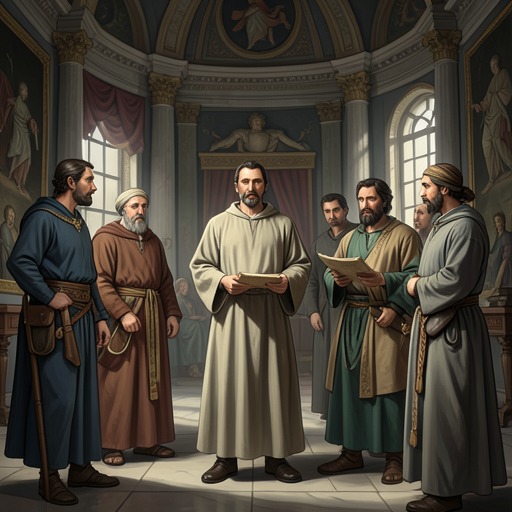
Bigthan and Teresh conspiracy
Book of EstherThe Bigthan and Teresh conspiracy is a thwarted plot against Ahasuerus’s life whose importance lies well beyond the danger it poses to the king. Mordecai discovers the conspiracy, but his service goes unrewarded at the time. The book’s interpretation makes that neglect part of the event’s significance: the unrecognized deed becomes a link in a longer sequence that will bring Mordecai to royal attention when the Jews face a later threat.
The plot and its discovery
The conspirators are two of Ahasuerus’s chamberlains. The account describes their plan to kill the king as arising from resentment over an injury or provocation, while emphasizing that their purpose was their own and not the service of God. The narrative does not specify the grievance or explain in detail how the plan was formed.
The conspiracy is made known and frustrated, and Mordecai is the person who discovers it. The discussion stresses how many circumstances had to converge: a plot had to exist, it had to be exposed, and its disclosure had to reach Mordecai. The account does not identify the means by which he learned of it; rather, it treats the fact that he was the discoverer as a consequential link in the larger story.
An unrewarded service
Mordecai’s discovery places him in a position to receive royal notice, but no reward follows immediately. The delay is striking precisely because saving a sovereign’s life might ordinarily be expected to bring prompt recognition. Instead, the deed is left forgotten while Haman receives favor and Mordecai remains without comparable advancement.
That omission shapes what follows. The account argues that if Mordecai had been rewarded when he first served the king, the later danger posed by Haman could not have unfolded in the same way. Mordecai’s unadvanced position leaves room for Haman to seek his ruin. Yet the delay is not allowed to continue indefinitely: the account sets the approaching danger against the threat of a gallows fifty cubits high, which Haman has prepared for Mordecai, and says that another day’s delay would have meant Mordecai’s death. The earlier service thus becomes consequential at the point when its long neglect can no longer be separated from the crisis.
A link in the Jews’ deliverance
The conspiracy is interpreted as an early provision for Mordecai’s later safety, elevation, and authority in defending his people. It occurs before the enemies of the Jews have prepared their destruction, so that a means of deliverance is already in place before the danger fully takes shape. The event’s significance therefore depends not only on the plot being stopped, but also on who exposes it and on the fact that his service remains available to matter later.
The account places this episode within a carefully connected sequence rather than treating it as an isolated court incident. It argues that removing the discovery would break a link in the chain leading toward the history’s larger outcome. In this reading, the event is one of the seemingly ordinary circumstances through which the Jews are eventually delivered, without a miracle interrupting the usual course of events.
Human purpose and providential meaning
The chamberlains act from their own resentment and remain responsible for their intention to kill the king. Their actions are not excused by the later use made of the conspiracy. At the same time, the account regards the plot’s exposure through Mordecai, and the future significance of his service, as ordered within God’s providence. It holds these claims together: the human agents pursue their own purposes, while their actions and even the delay in recognizing Mordecai contribute to an outcome they did not intend.
This combination gives the episode its interpretive force. The danger is real, the conspirators’ motives remain their own, and no supernatural intervention is described. Yet an event that appears contingent—the discovery of a court plot by this particular man, followed by the king’s failure to reward him—becomes part of the chain by which the Jews are protected. The episode thus establishes an early, easily overlooked condition for the later reversal of Mordecai’s fortunes.